Showing posts with label history. Show all posts

Sunday, April 21, 2013

Those Angry Days:Roosevelt, Lindbergh, and America's Fight Over World War II, 1939-1941


by Lynne Olson, Random House, March 2012

...a significant book telling an important story in a very readable way.

Lynne Olson tells the story of the fight between the isolationists and the interventionists in the months leading up the the entry of the US into WWII.  This detailed history reads like a novel. 

On the isolationist side, the author has rightly centered her story around Charles Lindbergh.  Lindbergh’s character and personality is revealed through his wife Anne’e writings and the diaries of other family members and friends.  He is really a fascinating character.  All of the characteristics that made him so successful in aviation - independence, self assuredness, even arrogance were all the wrong traits to make him successful in political discourse.  Because of the issues around his son's kidnapping and death and the intense publicity that surrounded him in the US he relocated to Europe in the 1930s and became enamoured with the regimented and controlled life in Nazi Germany.  There were a few other interesting characters on the isolationist side, including some senior US military (George Marshall, Hap Arnold) and young intellectuals like John F. Kennedy, Sarge Shriver, and Brewster King.  While the debate between the two groups started in a high minded way, the isolationist’s soon attracted all kinds of crazies (radical Catholics, Communists, racial purists, Jew haters) to their cause and the debate sank to new lows (sound familiar today).

The interventionist story is centered around FDR and those advisers (Stimson, Knox) who supported the British cause.  FDR is portrayed as uncharacteristically reluctant to voice support for the interventionist cause.  What I found interesting was the role played by individual citizens in promoting the selective service act and the provision of military equipment to Britain.  Additionally the British ambassador to the US, Lord Lothian was a truly heroic character, actually sacrificing his health and life to work promoting the British cause to Americans.

I liked this book but not nearly as much as two earlier WWII books the author had - Citizens of London, and A Question of Honor.  I think the subject matter dealt with here was just less exciting that either the war in Britain or the story of the Polish aviators.  Nonetheless this is a significant book telling an important story in a very readable way.


I read a copy of this book provided by the publisher

Friday, February 22, 2013

A Higher Call: An Incredible True Story of Combat and Chivalry in the War-Torn Skies of World War II

by Adam Makos and Larry Alexander, Berkley Hardcover, December 2012

...this story is tightly edited and all the more powerful for its brevity and focus


Some Spoilers  --  Yet another WWII story (I know too many!).  This one a true tale of chivalry in the air war in Germany.  Using a single instance of a German fighter pilot aiding the crew of a crippled US bomber the author takes the opportunity to describe life in the German air force for those who were not Nazis.  Telling the story of Franz Stigler, a Bavarian Catholic who served as a pilot we get the background on Hermann Goering’s air corps pilots, their esprit de corps, their life styles and their battles.  The author opens with Franz’s love of civilian aviation and reluctant recruitment into the air force.  He survives numerous crashes in Spain, Germany, and North Africa.  He flies over 400 sorties for the air force and comes to question the purpose of the war.  Remarkably he survives the war, the post war hardships in Germany and immigrates to Canada.

The US pilot in the story, Charlie Brown, is younger than Stigler and much less experienced than him when their paths cross in the skies over Holland.  But Charlie has many of the same experiences as Stigler, dealing with fear, a sense of despair and the strong feeling he won’t survive the war. 

I won’t tell the tale of their encounter because the author does it much better than I could, but it is a great story.  The author (an extraordinarily lucky man to find all of the key players alive and willing to be interviewed 50 years later) does a good job of interweaving the two stories.  The events that brought both pilots together 50 years later are almost as good as the original story.  This story is tightly edited and all the more powerful for its brevity and focus.  It continues to fascinate me that we can motivate young men (and women) to put their lives on the line in the way these two gentlemen did.  A great story that would bring up a number of interesting discussions for a book club.

I read a kindle edition of this book and again am unhappy with nonfiction on the kindle.  The images provided are awful and the documents shown are unreadable.  Come on guys at least provide a link to some good images if you can’t get them on the kindle.  No more nonfiction on the kindle for me! 

I read a copy of this book that I bought

Monday, January 7, 2013

The Last Lion: Winston Spencer Churchill, Volume Three: Defender of the Realm, 1940-1965


by Willaim Manchester and Paul Reid, read by Clive Chafer, Blackstone Audio, November 2012, 53 hrs.

...excellent conclusion to a great historical bio

I read William Manchester’s volume one and volume two of the Churchill biography when they were first published in the 1980s.  They both were tremendous books, majestic in scope and marvelous in riveting detail - in my opinion the quintessential biography of a historical giant Winston Churchill.  With Manchester’s illness and subsequent death I never thought there would be a final installment in this series that could compare to the first two.  I was wrong, Paul Read has completed the trilogy with the story of Churchill’s life from 1940 until his death in 1965 and it is excellent.

The book opens with a reintroduction to the Churchill personality, quirks and all.  He is presented as a Victorian gentleman (never drove a car or cooked a meal) in an emerging modern world.  Once the stage has been set the story begins as Churchill accepts the prime ministership in truly Britain’s darkest hour 1940.  Alone, with her army in retreat and the island isolated only Churchill through his words and actions rallied the British to face Hitler and overcome the long odds in front of them.  The story chronicles WWII from a British perspective.  Churchill’s total involvement in every facet of the war is fascinating, he dictates military strategy in one breath and takes on the intricacies of food rationing in the next.

Churchill’s understanding (or lack thereof) of the post war expectations of the British people is outlined.  His loss of the prime ministership late in the war because the public did not want him leading the post war economic comeback is another intriguing chapter in this story.  The story continues as the war ends and issues related to the USSR and communist aggression takes center stage.  Here also Churchill has recognized the threat well before most of the rest of the national leaders.  Interspersed with public events are Churchill’s relations with his wife and children.  He is a true disaster in this arena oblivious to anyone’s needs but his own.  The prodigious amount of alcohol consumed each day really makes me wonder how this man functioned in such an effective way.  Churchill’s public career after the mid 1950’s is essentially concluded although he continues to write until his death in 1965.

No part of this story is as exciting as the events in 1940-41.  It is not an exaggeration to say that if the British had not had Churchill they would have made a separate peace with Hitler freeing him to conquer the rest of Europe and all of Russia, radically changing the course of the twentieth century.  The author takes the reader inside of this story by providing the detail that brings it to life.

I listened to the audio version of this biography.  It was read by Clive Chafer and he was an inspired choice for this work.  When he was reading from Churchill’s speeches you felt like you were listening to the great man himself.  The audio version is not for the faint of heart, it is 53 hours long!  It worked for me because I had a lot of car travel to do in December so I got well immersed in it, but normally that would be a time commitment I’d be reluctant to give.

So in summary if you’ve read the first two volumes in this series, you will be well satisfied with the conclusion.  If you haven’t read volumes one and two and you are a history devotee get a move on and read them!

I listened to a copy of the audio version of this book provided by the publisher.

Friday, November 9, 2012

Spies, Code Talkers and Deceit in War


I listened to two audiobooks and read an ebook that I thought would group nicely together in a review because all dealt with deception in wartime.  From the straightforward story of the Navajo code talkers in the South Pacific in WWII, the MI 5 operation in Britain that fooled the Nazis in the D-Day landings to the the work of the British code breakers in WWI we have the work of small groups of creative people that changed the course of history.


Code Talker by Chester Nez and Judith Schiess Avila, read by David Colacci, Tanter Audio, 9 hours, 36 mins. December 2011


Nice WWII story about the Navajos who used their unique language to encode military info in the South Pacific. You also get  a look  into Navajo life in the 20th century as the author Chester Nez relates his life story.  It is a straight on story with out much editorial input or reflection on the part of the author.  Well read by David Colacci.


The Zimmerman Telegram by Barbara Tuchman, read by Wanda McCaddum.  Blackstone Audio, 7hrs, 11 mins.

All of the inside scoop on the entry of the US into WWI.  Background on the British code breaking effort (Room 40) and the personalities of the US, British and German players in international diplomacy.  Nobody is better than Tuchman at writing narrative history.  She hooked me years ago when I first read Guns of August.       Witty and irreverent in her writing, she is a pleasure to read.  She is able to take what are often long dead and faceless people and bring them to life.  First published in 1966 this story is as fresh today as it was then.  She is my all time favorite writer of history.  I listened to this one and was well served by the reading style of Wanda McCaddum.  She is a master of accents and easily slips between German, English and American.  At 7 hours a great audio book.


Double Cross by Ben McIntyre Crown Publishers, July 2012

Ben McIntyre is a talented story teller.  He weaves together the story of the British double agents who feed information to the Germans throughout WWII.  This eclectic group of people were as different from each other as was possible.  A Polish patriot, a Argentine society playgirl, a Serbian gambler, a Spanish patriot and a host of others make up the cast.  Their British handlers are the most imaginative group.  Throughout the war these people feed the Germans a combination of true but unimportant facts and patently false data. leading up to their master deception - convincing the Germans that the Allies would land at Calais not Normandy.  This deception froze in place significant numbers of German soldiers defending Calais.  Eisenhower himself credited this group with ensuring the success of D-Day. This is a great story full of fascinating anecdotes, the story of the Royal Pigeon Service had me laughing out loud.  The deception effort itself is a quirky peculiar British activity, almost like a PG Wodehouse novel (he's in the story too!).  Great history, well told!  

Tuesday, August 14, 2012

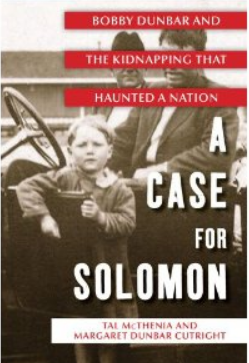
A Case for Solomon: Bobby Dunbar and the Kidnapping that Haunted a Nation

by Tal McTenia and Margaret Dunbar Cutright, Free Press, August 2012.

 ... a fascinating story that could have been edited a little better. 

This book tells the story of a sensational kidnapping of a four year old boy in Louisiana in 1912. The coauthors have produced an extremely well researched book. The story in a nutshell - Bobby Dunbar son of Lessie and Percy Dunbar disappears from a family campsite right around dinner time. Despite extensive search efforts no trace of Bobby is found. Initially it is believed he has drowned or perhaps been eaten by an alligator (remember we are in Louisiana) but as time goes on with no sign of him his parents become convinced that he has been kidnapped. Bobby has a distinguishing mark - a burn scar on his big toe. The public's fascination with the boy's disappearance leads to many reported sightings throughout the Gulf Coast. Bobby's father faithfully follows up on each sighting. Finally William Walters a travelling piano tuner accompanied by a young boy with a strong resemblance to Bobby becomes the focus of the search. Despite the fact that this boy does not have a scar on his foot and despite the fact that Bobby's parents do not immediately identify him as their son and despite the fact that after 8 months the child does not recognize the Dunbars nor a younger brother Alonzo the child is taken from Walters and taken in by the Dunbars as their son Bobby. When a destitute single mother from North Carolina Julia Anderson steps forward to claim the boy as her son Bruce Anderson she is consistently shunted aside.
SPOILERS AHEAD The story takes some twists and turns after this. Walters is tried and found guilty of kidnapping despite all kinds of evidence that should have helped acquit him. Various neighbors and friends are fairly sure that this child is not Bobby Dunbar. Through some strange legal maneuverings Walters is released from jail (again remember we are in Louisiana). The story follows the Dunbars through their post kidnapping life. Not a happy story - the Dunbar parents divorce and the boys grow to adulthood with the kidnapping as a defining family story.
The authors have managed to capture the state of the nation in this story. Lynching is a possibility as the public sentiment is inflamed against the accused kidnapper. The role that newspapers play in influencing public opinion is paramount in this story and well told by the authors. The legal system in Louisiana is not well evolved and is also a major culprit.
The real strength of this story though is that after years of uncertainty as to whether this child is truly Bobby Dunbar we finally get the answer through DNA testing. The child that was taken in by the Dunbar's as their son Bobby was not - he actually was Bruce Anderson.
One of the authors was the grandchild of the boy who was raised as Bobby Dunbar so we get a real inside family view. The one really amazing statement that Bobby Dunbar, this man of dubious identity made was - it doesn't matter where you've come from, it matters what you do with the life you are given. So true!
This is a good period piece of history. Don't use the ereader for this one, the accompanying pictures make the book purchase well worth it. The story went on a little long with perhaps too much detail; a better editing would have served it well. Despite that it is a fascinating read.

I read a copy of this book provided by the publisher.

Tuesday, May 8, 2012

Prague Winter: A Personal Story of Remembrance and War, 1937-1948

by Madeleine Albright, Harper Publishing, April 2012

...a marvelous personal account of monumental events

I do have a weakness for reading histories of the first half of the twentieth century.  Just when I think there can’t be anything new to learn about this time period I read a personal account of events that brings a whole new perspective.  Madeleine Albright, former US secretary of state, has written just such a history in recounting events in Czechoslovakia from 1937-1948.  Interspersed with these major events is the story of Albright’s own family.  Her father, Josef Korbel was a diplomat for the Czech government and worked in Prague before WWII, in London during the war and back in Czechoslovakia after the war.  His family, Albright and her mother and later a sister and brother accompanied him during this time.   
Albright who has access to her father’s diplomatic papers gives very good descriptions of the major players in this drama.  The larger than life founder of the republic; TG Masaryk is described as is Edvard Benes the Czech president in exile during WWII.  Czechoslovakia was really the only true eastern European democracy after WWI.  The republic was betrayed at Munich by the British and French when they ceded parts of Czechoslovakia to Hitler.   Albright tells this story from the Czech viewpoint and it reads like a thriller.  She also describes scenes and characters from the Czech resistance movement during the war who assassinated the Reich proctor, Reinhard Heydrich.  Again the detail in this story is riveting.  When the war ends the Czechoslovakia is again abandoned by the western allies and the Soviet Union adds Czechoslovakia to its group of satellite states in eastern Europe.  In the immediate post war years Albright’s father is a key player in the democratic government and is forced to leave the country after the Soviets murder Jan Marysk the pro western foreign minister.  Albright examines all of the evidence about Masaryk’s death and concludes as have most historians that he was murdered by the Soviets.
While the national events are interesting, Albright’s family story is fascinating.  As you might know, Albright found out in the 1990s that her heritage was Jewish and not Roman Catholic as she had thought.  Her parents became Catholics in Britain during the war and never discussed that decision with their children.  The family was not religious so I continue to be puzzled by this decision made in the relative safety of England in 1940.  Albright seems as mystified by the decision as I was.  Most of her extended family (grandparents, cousins, aunts and uncles) was lost in the Holocaust.  She discussed this in the book, and as with any story that puts faces on this horror it is quite moving.  Her family experienced the Blitz in London and the post war events in Prague and in Belgrade where her father was ambassador.  She details the leadership failings that allowed communism to rise in Czechoslovakia.  The book ends the story in 1948 when the Korbels immigrate to the United States. 
 I was interested to read this book because I will attend an author event where Albright will speak about the story.  Only in American could someone, a woman no less, come as an immigrant and end up as the secretary of state.  Can’t wait to hear her story first hand!
I read a copy of this book that I bought

Tuesday, January 24, 2012

Pearl Harbor Christmas

Pearl Harbor Christmas: A World at War, December 1941 by Stanley Weintraub, Da Capo Press, November 2011

...the author took on too many story lines and did not develop them enough to interest the reader


This story is a chronicle of events in the two to three weeksleading up to Christmas after the Japanese attack on Pearl Harbor in 1941. The author writes of Churchill’s visit to the White House where he meets extensively with Roosevelt and plans war strategy. It also touches on people and events in the Philippines where Mac Arthur is evacuating to Corregidor and where American soldiers and other military personnel (sans MacArthur) will make a doomed last stand. Some of the other story lines touch on events in Singapore, Hong Kong, Tokyo, Port Moseby, Wake Island, Russia and the UK. This is a short book, 228 pages and in my opinion touches lightly and inadequately on most of these story lines.

This is the type of book I usually love, a behind the scenes look at people that are at the center of world changing historical events. This book did not meet my expectations, I believe the author took on too many story lines and did not develop them enough to interest the reader. Other than the story line that followed Roosevelt and Churchill none of the other stories was told in enough depth or detail. Instead of well marked scene switches I found myself continually confused as the story venue changed – one paragraph dealing with the defense of Singapore and the next paragraph telling about events in Russia. The promise of a background story of the US in a festive but unsettled holiday mood also wasn’t meet; I found few interesting atmospheric details in the author’s story. The story was told chronologically and it just didn’t work. I think the story line was a good one but not well executed.

I read a copy of this book borrowed from the Free Library of Philadelphia.

Tuesday, November 1, 2011

Destiny of the Republic

Destiny of the Republic: A Tale of Madness, Medicne and Murder of a President by Candice Millard, Random House Audio, September 2011, narrated by Paul Read, 9 hours, 47 minutes.

It is the best kind of history to read -engrossing and all encompassing without been dry or stilted in anyway

In this gripping account of the murder of James Garfield, 20th President of the US, Candice Millard uses the assassination as a means to examine the culture and politics of America in the 1880s. My guess is if you remember anything at all about Garfield from US history it is that he was assassinated by a “disappointed office seeker”. Millard clears that one up early; he was killed by a man who was seriously mentally ill, certainly way more than disappointed.
We are treated to an examination of the US society fifteen years after the end of the Civil War. In 1880 the politicians are divided between those who support the spoils system (winners get to name their friends and supporters to federal offices) and those who are looking to reform the system into a meritocracy. Garfield is among the latter. Garfield was a poor son of an Ohio farmer who had worked to get himself a classical education. After service in the Union Army where he rose in the ranks to become a general officer he has won the US presidency through an unlikely series of events. After reading this story I am convinced that Garfield could have been a great president if he’d lived. He was certainly a top notch guy – well rounded, courageous, ethical, funny, empathic and intelligent

Garfield’s assassin, Charles Guiteau, receives almost as much background as Garfield himself. The author recounts Guiteau’s descent into mental illness. His unsuccessful marriage, his inability to hold a job, his chronic indebtedness and his delusions are all laid out. The parts of this story about Guiteau are downright scary and read like a thriller as he slowly moves toward the assassination.

Millard has a great gift in her ability to describe what it was like in the 1880s. One of the things that got my attention was that the president of the US, everyday had office hours where anybody (!) could make an appointment and meet with him. You just came to the White House, sat in the anteroom and waited to be seen. No security, little or no screening – amazing and this was only 130 years ago! In fact Garfield had spoken to Guiteau at least twice prior to the assassination. Garfield was shot at the train station in DC where he had gone accompanied only by his friend the Secretary of State, to board a train to vacation with his family at the Jersey shore.

The medical drama ensues after Garfield is shot. Antiseptic techniques have not been accepted by the majority of US physicians. Joseph Lister attended the Centennial celebration in Philadelphia and described his success with asepsis; he was ridiculed by the most eminent surgeons in the US. Garfield’s wounds were survivable; the bullet he took did not hit any major organs. He was most probably infected by the medical staff who continually probed his wound with unsterilized hands and instruments. He lived for 10 weeks as he slowly and painfully succumbed to overwhelming infection. The battles that took place between the arrogant physician in charge of his care (William Bliss) and younger colleagues who understood wound infection are all documented. This tragedy plays out almost in slow motion and really is heart breaking.

My review really doesn’t do justice to how good this book is. In an effort not to make the review too long I’ve left out lots of things that add to the richness of this story. It is the best kind of history to read -engrossing and all encompassing without been dry or stilted in anyway. If you read history or even if you don’t, don’t miss this one!
I listened to the audio edition and Paul Read was a good narrator, although some of the female dialogue he read was breathy and a little strange.

I listened to a copy of this story I bought from audible.com

Wednesday, October 26, 2011

Catherine The Great

Catherine The Great: Portrait of a Woman
 by Robert K. Massie, Random House, November 2011

Massie really can write history that reads like fiction.

Massie has taken the well know story of Catherine and written a highly readable Russian history. Catherine, whose baptismal name was Sophie was a teenager when she was brought to Russia by Empress Elizabeth to become the wife of Grand Duke Peter, heir to the Russian throne. When Sophie arrived she was unable to speak Russian, knew nothing of the customs and was directed to convert to the Orthodox religion from her German Lutheranism. She took the Russian name Caterina. Catherine’s marriage was deeply unhappy and the union remained unconsummated for 10 years. During that time she educated herself in all things Russian and worked to give herself a classical education corresponding with Voltaire, Grimm and Diderot. Catherine did produce a son but no one thought that Peter was the father. Evidently this was an unimportant detail in 18th century Russia. Her son Paul was recognized as a member of the royal family and in line for the throne.

When Peter finally came to the throne his reign was short and dysfunctional. In a coup he was removed from the throne and Catherine declared Empress. In 1762 she began her 35 year rule of Russia. She reigned with compassion and intelligence. She worked to improve medicine in Russia, becoming the first to be inoculated against smallpox and ensuring the vaccine was available in Russia. She amassed a collection of European art that even today is unrivaled. She instituted a legal code and extended the boundaries of the empire to borders that stood until 1991. She built schools and orphanages and developed curricula that provided for a broad education for those lucky enough to get schooling.

Catherine’s personal life was also fascinating. Massie identifies over 10 men who were her lovers. She was passionate in all aspects of her personal life. In addition to ensuring her lovers had a pretty face she looked for intellectual stimulation. She was serially monogamous. Her most serious and long standing relationship was with Gregory Potemkin. Massie postulates but doesn’t prove that Catherine and Potemkin were married. They remained lifelong friends and allies. She enabled him to essentially rule southern Russia, developing the city of Odessa to give Russia a port on the Black Sea.

This 600 page story flew by for me. Massie really can write history that reads like fiction. Strongly recommended for those who love history!

I read a copy of this novel supplied by the Amazon Vine program

Thursday, August 4, 2011

To End All Wars

by Adam Hochschild, Houghton Mifflin Harcourt, May 2011

...definitely worth the time for those who enjoy reading history.

The author takes a different angle in this very readable WWI history. Drawing portraits of those British who opposed the war – aristocrats, journalists, ordinary folks, suffragettes, Irish patriots and even a former prime minister- Adam Hochschild brings them to life. The story is told chronologically from Queen Victoria’s diamond jubilee through the Boer War (a new slice of history for me) right up and through the carnage that was WWI.

This is as much a social history of the times as a military story. The backgrounds of the two major military players (Douglas Haig and John French) are told in detail including the story of French’s sister Charlotte Despard a leading pacifist and antiwar demonstrator. Since the causalities of the war were more likely to come from Britain’s ruling classes (including the son of Rudyard Kipling, brother of the future queen, etc.) the courage that it took to oppose this conflict was considerable. The author tells these stories in a fairly even handed unemotional way. He doesn’t shirk the telling of the trench warfare though. The military strategy (?) employed by every general in this war was to send men directly into the fire of machine guns where little or no progress is made in four years of fighting. The losses incurred on the battlefields are truly incredible, while this story is told with Britain at the center; the numbers of men killed or wounded throughout Europe were stunning. You really have to read these sections of the story in small bites to let some of this senselessness sink in.

The characters that Hochschild has chosen to focus on really give the story a view into every social stratum in Britain. Douglas Haig the commanding general throughout most of the war and a good friend of the King is a window in to the unimaginative world of what was the British military command. Charlotte Despard and Emily Hobhouse were aristocratic Brits who actively worked to oppose this war and in Hobhouse’s case was the only Brit who attempted to bring the two sides to the negotiating table during the war. The story of the Wheeler family set up and tried for treason gave a view of socialist/communist sentiment among the working classes. The Pankhurst family, prominent suffragettes divided by their sentiments on the war shows the women’s movement in the early 20th century and also the rise of communism among the British. Kier Hardie, a socialist MP, an early critic of Britain’s involvement in this conflict is profiled and speaks for many unionists in the country. The power of the empire and British nationalism overwhelm Hardie and most socialist hopes for international cooperation that would have avoided fighting among the working classes.

In addition to being a fairly good recounting of WWI, this book does a great job of describing Britain in its waning days as a colonial power. While not quite on the same level as Guns of August, Tuchman’s masterpiece history of the beginning of this conflict, it is definitely worth the time for those who enjoy reading history.

I read a copy of ths book borrowed from The Free Library of Philadelphia.

Monday, July 18, 2011

In the Garden of Beasts

In the Garden of Beasts: Love, Terror, and an American Family in Hitler's BerlinIn the Garden of Beasts: Love, Terror, and an American Family in Hitler's Berlin by Erik Larson, Crown Publishing, May 2011

...a totally different view of the time period


Having read many books about WWII and the run up to it I was pleasantly surprised at Erik Larson's contribution to this body of work.  He tells the story of William Dodd, an unlikely choice to be America's ambassador to the new German government formed by Adolf Hitler in 1933.  Dodd, on paper unqualified for the job, comes from an academic background teaching in Chicago.  A self described "Jeffersonian democrat" he responds to Roosevelt's request to fill this position.  He moves his wife and two adult children, Martha and Bill to Berlin.  Martha is recently separated from an older husband and open for adventures of all kinds in Europe.

In retrospect it is easy to see the evil that was Hitler's Reich.  In 1933 as he was coming to power in Germany things were much less clear.  The primary concern of the US government appears to have been getting Germany to repay US loans (the large financial institutions making self serving decisions as usual).  To his credit William Dodd early on recognized the evil aspects of Hitler's regime.  When the career US diplomats were cautioning against any opposition to Hitler, Dodd was making speeches that warned of the lawlessness and arms building occurring in Germany.  In 1933/34 Hitler's power was far from absolute and you can only speculate what might have happened if some governments - US and European - had spoken out as Dodd wanted.

Dodd's daughter Martha had a different take on the new regime.  She had a romantic relationship with at least one military officer in the SS.  While initially enamoured of the energy and charisma of Hitler, she witnesses at least one attack by "brown shirts" and recognized the developing hatred of the regime for the Jews.  She has several affairs while in Germany and develops a lasting relationship with a Russian embassy officer, at least until he is terminated by Stalin.  Her story captures the cosmopolitan atmosphere of Berlin in the 1930s.  She too in the end recognizes the evil in the Nazi government.

Both Dodd and his daughter were faithful diarists enabling the author using the diaries and other sources to reconstruct an almost day by day account of those times.  It is a totally different view of the time period from what you would read in most histories.  It reads almost like gossipy fiction.

My one criticism of the book is that it was remarkably devoid of photos.  I've come to expect them in non fiction stories like this and there were very few throughout the text.

Friday, May 20, 2011

Lost in Shangri-La

Lost in Shangri-La: A True Story of Survival, Adventure, and the Most Incredible Rescue Mission of World War II
Lost in Shangri-La: A True Story of Survival, Adventure, and the Most Incredible Rescue Mission of World War II by Mitchell Zuckoff, read by Mitchell Zuckoff, April, 2011, Haper Audio 8hrs, 32 min.

If you like a good adventure tale this one is for you no two ways about it!

Just when you think you’ve heard every WWII story there is to hear a new one comes along. First there was Unbroken the inspirational life story of Louis Zamperini and now we have Lost in Shangri-la a story of survival in the remote jungles of Dutch New Guinea.

In spring of 1945, when the war in Europe was won and the invasion of Japan was looming a group of 24 Army personnel including 9 WACS were on a sightseeing over flight of an impenetrable valley in the highlands of New Guinea. The valley had a great allure to the Americans because it was thought to be populated with primitive people perhaps cannibals whose lives were untouched by modern society. The plane nicknamed the “Gremlin Special” crashes into the side of a mountain within the confines of the valley. Six people survive the crash although three die within the first 24 hours. A young lieutenant, John McCollom who was relatively unhurt and two badly burned survivors, sergeant Kenneth Decker and an Army stenographer Margaret Hastings. The survivors almost immediately come in contact with the native people and develop an uneasy relationship. The army locates the survivors quickly but does not have a clue how to extract them from these jungles. Enter the real heroes of the story – Captain Earl Walter and the Filipino members of the First Recon Battalion (special). Two members of this group – medics Doc Bulatao and Rammy Ramirez parachute into the jungle and begin to treat the burn victims whose wounds have worsened. Capt. Walter and other paratroopers establish a base camp miles away. The groups connect and so begins a long wait as the army ponders how to get them out. The interactions with the native population advance from hostility to a developing mutual respect. There is a lot of humor and misunderstanding in these encounters and an underlying tension that never quite leaves the narrative. I won’t reveal how the army rescued this group because I think the actions were so thrilling you’d swear they were fictional.

Mitchell Zuckoff has nailed this story. He was aided by army records, a diary kept by Margaret, WWII home front interviews with families of the lost and missing, interviews with the few surviving participants, interviews with relatives of deceased personnel, and lastly interviews 50+ years later with some of the New Guinea peoples who were there. The native interviews enhance this story greatly; hearing their interpretations of the events was fascinating. The story is enriched with all of this detail. I really enjoy the book; my father spent a goodly portion of the war in Dutch New Guinea so I was pleased to learn so much about the Army Air Corps experience there.

I listened to an audio of the story read by the author which was a real plus in this case (not always true!); I did miss seeing the pictures of the people involved but if you go to the Amazon website they are posted there. If you like a good adventure tale this one is for you no two ways about it!

I listened to an audio of this story provided by Harper Audio

Monday, January 24, 2011

Operation Mincemeat

Operation Mincemeat: How a Dead Man and a Bizarre Plan Fooled the Nazis and Assured an Allied Victory
by Ben MacIntyre, Audio CD 11 hours, 18 mintues, Random House Audio, May 2010
Read by John Lee

If you like spy thrillers give this one a try it's a keeper!

Operation Mincemeat is the story of a little known British subterfuge leading up to the Allied invasion of Sicily in 1943. The story was told incompletely in the 1950s book The Man Who Never Was. The British Naval Intelligence service invents the identity of a naval officer and releases his dead body loaded with intelligence papers off the coast of neutral Spain in 1943. The entire ruse comes from the minds of a group of British novelists who are serving officers in the intelligence service. All of the creative detail that makes this trick so successful comes from these literary minds. The most recognizable name involved is Ian Fleming but there are several other writers serving in this unit and participating in this operation.

The story reads like the best international spy thrillers. The Brits make up a complete back-story for the dead body complete with family and fiancée. Securing a dead body and preparing it for use in a way that will fool the Nazis is key to the ruse and is more luck than skill in this operation. The papers the dead officer will carry are prepared at the highest levels of the Allied war command with Eisenhower, Churchill and Montgomery giving input on what should be in them. The body is transported clandestinely by submarine and carefully released off the Spanish coast and almost immediately recovered. A tense week ensues as the Spanish Fascists attempt to recover the papers. They succeed and the papers are soon in German hands. The Germans fall for the deception hook, line and sinker moving troops away from Sicily and to the decoy target Greece. The author has access to many official papers in both the British and German governments that allow for a telling that is very complete at each step along the way.

The audio book I listened to was read by John Lee and he was marvelous! He was able to switch between English, German, Spanish, American and French accents effortlessly and in my opinion really added to the pleasure of listening to this story. If you like spy thrillers give this one a try it’s a keeper!

I listened to this story on AudioCDs borrowed from The Free Library of Philadelphia.

Friday, December 3, 2010

Unbroken

Unbroken: A World War II Story of Survival, Resilience, and Redemption
by Laura Hillenbrand, Random House,November 2010

Unbroken has a hero for the ages, adventures so fantastic as to be unbelievable, unforgettable characters, life affirming redemption and forgiveness all written in the most elegant readable prose. Read this book!

Unbroken is the amazing story of Louie Zamperini, a first generation American. Louie grows up in pre WWII California as the local juvenile delinquent always in some type of minor trouble. He leaves his troubled life and with help from his brother trains into a world class runner, who in an incredibly short time wins a spot on the 1936 American Olympic team, competes in Berlin, meets Hitler and steals Nazi souvenirs! Louie joins the Army Air Force (AAF) washes out of pilot training and becomes a bombardier. Louie survives a Japanese attack on his base, and an air mission where his plane is incredibly disabled but returns to base. Louie is downed in the Pacific and with his pilot and another crewman drifts 2000 miles in the Pacific on a disintegrating raft. During this time they are strafed by enemy planes, fight off sharks that attack them in the raft, are scorched by the relentless sun and overcome debilitating hunger and thirst during their 47 day ordeal. This story could end right here and it would be a worthwhile inspiring story but the suffering is just beginning. Louie is captured by the Japanese and over the next two years is shuffled through a number of POW camps where the prisoner treatment is heartbreaking.
This is an incredible book; Laura Hillenbrand has taken an iconic story and turned it into a gripping page turner. I read the book in two days, I couldn’t put it down. She has integrated the story of the Pacific airmen into Louie’s narrative in a seamless way. The extensive research that served Hillenbrand so well in Seabiscuit is here also. It adds to the power of this story. Her sources for Louie’s early life allow her to give an in depth portrait of Louie as a young man. So when the war starts we know him well. Her telling of his ordeal is masterful, it isn’t really clear to me how she is capable of bringing such drama to a known story but it was there for me.

The account of the POW experience from Louie and other prisoners is deeply disturbing, what these men endured and lived through was awful. Hillenbrand makes the point that the loss of dignity that they endured was more debilitating than the physical torture. Make no mistake the physical torture was appalling. While a small number of Japanese helped the POWs many more were hostile. Hillenbrand points out that the death rate among Pacific POWs was between 25-37% while in Europe it was less than 2%. Death was never far from them. As the POWs received news of the coming allied victory most believed the Japanese would execute the POWs when Japan lost the war. This actually happened to the POWs on Wake Island and in some other camps. The POWs incredible spirit and hope in the face of such adversity was an inspiring theme in this story.

{SPOILERS in this paragraph}  Hillenbrand deals with Louie’s life after the war. He was suffering from post traumatic stress disorder but that diagnosis was unknown then. He sinks into alcoholism and self destructive behavior as his personal life disintegrates. Of all he endured I found this part most disheartening. Hillenbrand points out that the majority of Pacific POWs came home with life altering physical and mental problems. It seemed so unfair after all they endured not to get a happy ending. Fortunately Louie, ever the strong soul, has a Christian conversion and rights his life. In an extraordinary act Louie returns to Japan meets with his guards and forgives them! I did not have the same reaction and was unhappy that his chief torturer, “the Bird” was able to live out his life without paying for his cruelty and murderous behavior. Louie’s true revenge is a life well lived, he continues in good health today at the age of 94!

As I finish this review I’ve thought of six other things about this book worthy of discussion but don’t want to make the review too long. Run to your favorite bookstore and get this book! It has a hero for the ages, adventures so fantastic as to be unbelievable, unforgettable characters, life affirming redemption and forgiveness all written in the most elegant readable prose.

I read a copy of this book borrowed from The Free Library of Philadelphia.

Thursday, October 28, 2010

Scorpions - Review and Giveaway

Scorpions: The Battles and Triumphs of FDR's Great Supreme Court Justices
by Noah Feldman
November 2010
Twelve

Scorpions – the title references a description of the Supreme Court Justices as “nine scorpions in a bottle” – is the story of four widely different justices all appointed by Franklin D. Roosevelt.  These four, Hugo Black, Felix Frankfurter, Robert Jackson and William O. Douglas could not have been more dissimiliar.  Frankfurter, a Jew was perhaps the most liberal voice in the country when Roosevelt appointed him to the court.  Black was a southern country lawyer former KKK member with an altogether unique interpretation of the constitution, Jackson, a plain spoken lawyer seeking a pragmatic resolution to court cases and Douglas, a westerner who defined wide limits for individual freedom.  I enjoyed the detail and back story the author presented on all of these men.  The intellectual growth that allowed these men to listen, learn and change their minds from where they started was so appealing in this story.  Black from a KKK member to perhaps the strongest civil rights supporter on the court.  Frankfurter from the most liberal to arguably the most conservative member of the court. I was fascinated at how men of such widely divergent backgrounds could come together to decide some of the most important issues of the twentieth century.  The background of the Japanese internment in WWII, Truman’s seizure of the steel mills, civil rights and lastly the Brown v. the Board of Education decisions are all covered with the deliberations and interactions that led to the court decisions.  Personalities are on full display.  I admit much of the legal theories were lost on me and did for me (the clearly non legal reader) drag out the story a bit but I still enjoyed this book as a history of the Supreme Court and the justices who served there.  In today’s acrimonious political environment one really longs for the time when disagreements were discussed, debated and had compromises developed that moved the country forward.  A good narrative history of the Supreme Court in the mid twentieth century.
I have three copies of SCORPIONS for a giveaway, if you would like to participate, click here. 


Sunday, September 12, 2010

The Immortal Life of Henrietta Lacks

The Immortal Life of Henrietta Lacks

by Rebecca Skloot
Read by Cassandra Campbell and Bahni Turpin
Random House Audio
February 2010

This was an audio book that I listened to over a 2 week period. I usually have an audio book from the library in my car as I spend a significant amount of time driving alone especially in the summer. Most of the audio books I listen to are eminently forgettable but not this one! It was recommended by Jen at Devorer of Books (a great blog) as part of the Audio Book Week in June.

This book melds the two very different stories of the family of Henrietta Lacks, a poor African American woman, who died tragically at Johns Hopkins Hospital of an aggressive cervical cancer in 1951 and the story of her cancer cells (called HeLa cells) that were harvested from her tumor and used by medical researchers throughout the world for the next 50 years without the knowledge or permission of her family.

The author has done an extensive research job in putting together this book. The afterword notes that it took 10 years to complete the book. She did a great job. The science is easily understood by the average reader, the family story is enhanced by the author’s patient relationship with the family of Henrietta. The science side of the story is a history of medical/laboratory research in the 20th century told with the HeLa cells as the central player. The life of Henrietta and her family is a history of rural African Americans who migrate to the big city – Baltimore and all the problems that were part of that story. The author intertwines these stories in a masterful way.

Let me start with the science and medicine. I loved this part of the story. As a med tech that started working in the 1960s my career began at the end of this era. In the 1960s, the MDs were still gods almost never questioned by anyone, patient informed consent was totally unknown, reagent companies were in their infancy, lab techniques were far from standardized, medical conferences were often peppered with public fights between different research camps, mailing blood samples around the world in card board boxes was standard practice and there were remnants of racism in medical care. The reader is treated to detailed reviews of these topics and lots of others always tying the topic back to the HeLa cell cultures. I was further entertained in the story when it turned out I actually knew some of the medical folks from Fox Chase Cancer Institute and Johns Hopkins who played a part in this story (I actually almost drive off the road as I listened to the Hopkins section!). Learning of some of the dubious ethical studies that occurred in the 1950s, ‘60s and ‘70s gave me knew respect for the development of informed consent policies and the role of Institutional Review Boards in protecting patient rights.

The story of Henrietta Lacks and her family is gripping. While the HeLa cells were in wide use in laboratories throughout the world her family had no idea until 1975 that their mother’s cells had been harvested and continued to exist. Following their identification as the family of the HeLa cell donor they are harassed and besieged by reporters and other charlatans. The author in a skilled way shows the two very different versions of the same events told by the mostly white medical establishment and the poor black Lacks family. Henrietta had five children, only one of whom was old enough to have memories of her. The children were each haunted by the existence of these cells and the effects on them were different. Her daughter, Deborah is a central character in the story. Never really knowing her mother she searches for some aspect of her mother’s life in the cell culture story. Hampered by the lack of an education she slowly, with the author’s help, comes to know the impact that her mother’s cells have had in medicine. I was really moved by the growth that Deborah shows over the course of investigating these events. I was also moved by her lack of anger against the medical field and institutions that had treated her family with such wanton disregard. In the end for me, she was the most memorable character assuming a kind of goodness and dignity denied to her mother.

Lastly what I liked about this book is the way the author presented the story in a non judgmental way. Both the family and especially the medical establishment committed acts that did no one proud. She is not condescending nor patronizing to the Lacks family; she does not condemn the medical establishment. It would have been easy to sensationalize this story but she didn’t, she just calmly and in a very fair and straightforward way reported it.

This book tells a poignant human story surrounded by compelling medical science. Folks with no science background could and should read this book but it should be required reading for medical professionals. It is hard to believe that this was a debut book for Rebecca Skloot, here’s hoping for many more!

Saturday, July 3, 2010


by Miranda Carter
March, 2010
Knopf

The author has written an excellent comparative account of the lives of Nicholas II of Russia, Wilhelm II of Germany and George V of England. These monarchs all reigned in pre World War I Europe in a time of great change. They are all related - Wilhelm and George are grandchildren of Victoria and Nicholas is married to Victoria’s favorite granddaughter. What a dysfunctional family! The author recounts the lives of these monarchs from 1858 until after WWI. Both public events and private family gatherings are covered. The author does a great job using primary sources to tell intimate details of family gatherings and relationships. None of these monarchs were really educated, none had experiences that allowed them to in any way understand the social change that was going on in Europe and each of them was profoundly out of touch with their people. Queen Victoria’s plan to tie together all of the European royals through intermarriage resulted in royals who were distinctly unqualified to lead their countries. The way that Europe lurches and stumbles toward WWI is told through the individual actions of these monarchs. While George and Nicholas did not cause the war, they did nothing to strengthen their governments that might have allowed a saner course to be taken. Wilhelm appears as the most dysfunctional of the trio. Bellicose and arrogant, his public rantings incite a war climate within Germany and spread fear throughout the continent. Nicholas lived in a privileged cocoon and did not interact with the Russian people at all; he was completely taken aback by the events up to and including the revolution. George while having less power than the Nicholas or Wilhelm manages to be totally spineless, refusing to take the risk of giving asylum to Nicholas and his family and then denying it after the assassination of the czar. What a motley crew, it only made me wonder why anyone would think hereditary monarchy would be a form of government worth having. This is a good book and an easier than expected read. I’d recommend it to those interested in nineteenth century early twentieth century European history.

Tuesday, June 22, 2010

Wild Swans

Wild Swans : Three Daughters of China
by Jung Chang
Simon & Shuster
2001

This is an epic book. I can’t imagine that anyone will write a narrative of 20th century China that will approach the richness of detail, breath of topic and unsettling nature of this work. The author tells the tale through the stories of three women – her grandmother Yu-Fang, her mother Bao-Qin and herself. China’s 20th century included the demise of the feudal warlords, the Japanese invasion, the fall of the Nationalist (Kuomintang) government, the rise of Mao-Tse-Tung, the installation of communism as the national government, and the chaotic Cultural Revolution. Jung Chang’s family is caught up in all of these events.


Her grandmother was born into feudal China. Her feet were broken and bound in an effort to keep them from growing, a practice common in the first half of the twentieth century in China. She was essentially sold as a concubine to a warlord (translate gangster) general twice her age. She spent very little time with him but did conceive one child, the author’s mother. She then marries a Manchurian (Manchuria a place more foreign that China if that is possible) doctor, has some frightening experiences with both the doctor’s family and then during the Japanese invasion in the 1930s.

The author’s mother, Bao-Qin, is an early convert to communism. It is not hard to understand how communism engaged the people of China. The repressive nature of the Nationalist regime and the obscene difficulty of life (famine and starvation were common, women were held as property) made the communist movement an attractive egalitarian choice. The author’s father, Wang-Yu, is also with Mao early in the communist movement. He actually makes The Long March with Mao. Her father dedicates his life to the principles of the communist movement, an allegiance later betrayed. Both of her parents are senior officials, intellectuals and enthusiastic nation builders as the communists take over China and try to improve conditions for the populace. The early years of the communists are good, and much of China thrives. The government evolves into a personality cult of Chairman Mao and the country essentially falls apart in the 60’s. I found the descriptions of the events of the Cultural Revolution horrifying. Mao did not persecute the country using government agencies but he incited the people to turn on one another. It was heartbreaking and frightening to see the evil that people inflicted on their friends and neighbors. The author’s family survives this period, but barely. Her father who had dedicated his life to the communist agenda is denounced and arrested when he takes principled stands against corruption. He is “relocated” to the countryside for years of “reeducation”. He suffers a nervous breakdown and is dead at the age of 54. Her mother is also denounced and relocated. The author recounts her time as a Red Guard and her very gradual disillusionment with Mao and his actions. The Cultural Revolution which started slowly in the late 1950s doesn’t really end until 1975 – almost 20 years of torture for China.

The book ends when Chairman Mao dies, the Cultural Revolution is over and some semblance of normalcy returns to China. Education at all levels had been suspended for 8 years and is slowly reestablished. The author is able to leave a factory job and through merit become a university student studying English.

This is not a book to be read in a short sitting. You really could walk away from it for a couple days as some of the scenes are very intense and gripping. It can be hard to believe you are reading non-fiction. The author clearly and interestingly tells you the story of her family.   I think though it is an important book giving witness to cataclysmic events through the eyes of three incredibly strong women.  I was familiar with much of this history but had no understanding of the Chinese people and what they have endured until I read this story.   I’d recommend it for anyone traveling to China or interested in Chinese history. I was in China in 1984 and would have loved to have had read this story before that assignment.