Friday, April 26, 2013

Paris: The Novel


by Edward Rutherford, Doubleday, April 2013

...for the diehard historical fiction fans

Hold onto your hats, we have an 800 page(get it on your favorite ereader)  fictional look at Paris that starts in 1260 with the building of Notre Dame Cathedral and finishes in 1968 with the student revolts.  The story follows several families through the years - the LeSourds who are revolutionarys, the Blanchards middle class merchants, the Gascons skilled labourers and the deCynges who are aristocrats.  In what I guess is typical for European society, they never change class - aristocrats from the 13th century are still aristocrats in WWII, etc.   

There is so much ground to cover that the author sacrifices character development for historical detail.  No major milestone in Parisian history is unrecorded in this story.  The wars with England, the expulsion of Jews, the Revolution, the Paris Commune, building the Eiffel Tower, the Franco-Prussian War, WWI and II are all part of it. I would have preferred a little less history and a little more depth of character but not to be.   The bulk of the tale is set between 1860 and 1945 but in a decision that I found hard to follow the author jumps back and forth in time in telling the tale.  The author is very descriptive about Paris neighborhoods; I do not have a familiarity with the geography of the city but if you do I bet you will like this aspect of the story.  Even though I read and mostly enjoyed this tomb I’d be hard pressed to recommend it to any but die hard historical fiction fans.

I read a copy of this novel provided by the publisher

Sunday, April 21, 2013

Those Angry Days:Roosevelt, Lindbergh, and America's Fight Over World War II, 1939-1941


by Lynne Olson, Random House, March 2012

...a significant book telling an important story in a very readable way.

Lynne Olson tells the story of the fight between the isolationists and the interventionists in the months leading up the the entry of the US into WWII.  This detailed history reads like a novel. 

On the isolationist side, the author has rightly centered her story around Charles Lindbergh.  Lindbergh’s character and personality is revealed through his wife Anne’e writings and the diaries of other family members and friends.  He is really a fascinating character.  All of the characteristics that made him so successful in aviation - independence, self assuredness, even arrogance were all the wrong traits to make him successful in political discourse.  Because of the issues around his son's kidnapping and death and the intense publicity that surrounded him in the US he relocated to Europe in the 1930s and became enamoured with the regimented and controlled life in Nazi Germany.  There were a few other interesting characters on the isolationist side, including some senior US military (George Marshall, Hap Arnold) and young intellectuals like John F. Kennedy, Sarge Shriver, and Brewster King.  While the debate between the two groups started in a high minded way, the isolationist’s soon attracted all kinds of crazies (radical Catholics, Communists, racial purists, Jew haters) to their cause and the debate sank to new lows (sound familiar today).

The interventionist story is centered around FDR and those advisers (Stimson, Knox) who supported the British cause.  FDR is portrayed as uncharacteristically reluctant to voice support for the interventionist cause.  What I found interesting was the role played by individual citizens in promoting the selective service act and the provision of military equipment to Britain.  Additionally the British ambassador to the US, Lord Lothian was a truly heroic character, actually sacrificing his health and life to work promoting the British cause to Americans.

I liked this book but not nearly as much as two earlier WWII books the author had - Citizens of London, and A Question of Honor.  I think the subject matter dealt with here was just less exciting that either the war in Britain or the story of the Polish aviators.  Nonetheless this is a significant book telling an important story in a very readable way.


I read a copy of this book provided by the publisher

Tuesday, April 16, 2013

His Majesty's Hope: A Maggie Hope Mystery


by Susan Elia MacNeal, Bantam, May 2013

... a fun series

This is the third novel in this WWII mystery series.  Maggie Hope, a Brit who was raised in the US is the heroine.  The first novel in the series, Mr Churchill’s Secretary introduced Maggie as a feisty, independent woman with a head for breaking codes and a propensity for attracting danger.  In the second novel Princess Elizabeth’s Spy, Maggie has joined the SOE (Special Operations Executive) and protects the young princesses from intrigue as she learns more about her own convoluted family history.

This story finds Maggie fully trained and ready for an overseas assignment.  The year is 1941 and Maggie finds herself chosen by Churchill himself to conduct  a dangerous mission  that takes her right into Berlin. Lots of danger and suspense here and you are almost sure that things will not go well for Maggie. In addition to her mission she uncovers more info about her family that is very interesting.

The author does a great job with historical detail.  I also love the fact that she mixes real life characters with fictional ones.  You get a good picture of life in Berlin circa 1941. The characters are rich and well drawn.   This is a fun series so I almost hate to make any negative comments because I do enjoy it, but the author relies on an inordinate amount of coincidences to further the story line.  I think the story would be just as compelling with slightly less of these far fetched add ons. Having said that, if you like WWII mysteries with strong female heroines, this series is for you.  Can’t wait for the next story - The Prime Minister’s Secret Agent in 2014.

I read a copy of this book provided by the publisher.

Friday, February 22, 2013

A Higher Call: An Incredible True Story of Combat and Chivalry in the War-Torn Skies of World War II

by Adam Makos and Larry Alexander, Berkley Hardcover, December 2012

...this story is tightly edited and all the more powerful for its brevity and focus


Some Spoilers  --  Yet another WWII story (I know too many!).  This one a true tale of chivalry in the air war in Germany.  Using a single instance of a German fighter pilot aiding the crew of a crippled US bomber the author takes the opportunity to describe life in the German air force for those who were not Nazis.  Telling the story of Franz Stigler, a Bavarian Catholic who served as a pilot we get the background on Hermann Goering’s air corps pilots, their esprit de corps, their life styles and their battles.  The author opens with Franz’s love of civilian aviation and reluctant recruitment into the air force.  He survives numerous crashes in Spain, Germany, and North Africa.  He flies over 400 sorties for the air force and comes to question the purpose of the war.  Remarkably he survives the war, the post war hardships in Germany and immigrates to Canada.

The US pilot in the story, Charlie Brown, is younger than Stigler and much less experienced than him when their paths cross in the skies over Holland.  But Charlie has many of the same experiences as Stigler, dealing with fear, a sense of despair and the strong feeling he won’t survive the war. 

I won’t tell the tale of their encounter because the author does it much better than I could, but it is a great story.  The author (an extraordinarily lucky man to find all of the key players alive and willing to be interviewed 50 years later) does a good job of interweaving the two stories.  The events that brought both pilots together 50 years later are almost as good as the original story.  This story is tightly edited and all the more powerful for its brevity and focus.  It continues to fascinate me that we can motivate young men (and women) to put their lives on the line in the way these two gentlemen did.  A great story that would bring up a number of interesting discussions for a book club.

I read a kindle edition of this book and again am unhappy with nonfiction on the kindle.  The images provided are awful and the documents shown are unreadable.  Come on guys at least provide a link to some good images if you can’t get them on the kindle.  No more nonfiction on the kindle for me! 

I read a copy of this book that I bought

Tuesday, February 12, 2013

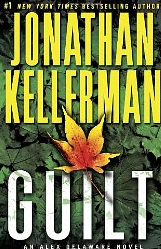
Guilt


by Jonathan Kellerman,  Ballantine Books, February 2013 

...the energy and suspense have gone out of this series for me


Guilt is the newest offering in the long running Alex Delaware series.  The early books in this series emphasized the psychological skills and interest of Delaware.  They were taut thrillers.  In the more recent books, Milo Sturgis, Delaware’s police lieutenant pal has become a central character as the series has moved into a more straightforward murder mystery type story.

 In this novel a series of seemingly connected events in an upscale LA neighborhood start the story.  The bones of an infant long dead are found buried in a yard of a home.  Nearby, the body of a woman and the bones of a second infant are found.  Milo conducts the investigation that leads to a power Hollywood couple (read Brad and Angelina) and their unusual life style. There are a few twists and turns before the murderer(s) are identified in the improbable ending.

As you can probably tell from my tepid review of this book, the energy and suspense have gone out of this series for me.  I find these stories to be just average police murder mysteries.  The characters have become predictable in their actions and the endings of these stories wildly unrealistic.  I will pass on the next book in this series.

I read a copy of this book provided by the publisher. 

Thursday, February 7, 2013

Leaving Everything Most Loved


by Jacqueline Winspear  Harper, March 2013

...long time fans will be well pleased with this one.

The tenth novel in this series in the Maisie Dobbs series and it is a good one.  The year is 1933 and Maisie, a psychologist and private investigator, is asked to investigate the murder of an Indian woman.  It was common practice in England for British families returning from Indian service to bring an Indian amah to care for their children.  Unfortunately when the children are grown, the families often just released these women into a land that did not welcome them.  Usha Pramal the woman who was murdered was a charismatic well educated Indian, beloved by all who knew her.  Her murder was not well investigated by the police and her brother newly arrived from India asks Maisie to investigate.   The murder investigation takes the expected twists and turns as Maisie works slowly but competently towards capturing the murderer.

One of the hallmarks of the Maisie Dobbs novels is that they are well grounded in time and place- in this one London in 1933.  A small number of people led by Churchill and joined by Maisie’s love interest James Crompton are preparing for what they see as inevitable war with a rearming Germany.  Women are struggling to gain opportunities in the working world, in this story highlighted by Maisie’s assistant Sandra Tapley.  The devastating effects of WWI on the British continued well into the 1930s and we see this with the lingering effects on the health of Billy Beale, Maisie’s friend and assistant.  Lastly the overt racism that was common to the times is a consistent theme in this murder investigation.

On the personal front, Maisie continues to be unable to take the step and marry the incredibly patient James.  She has decided to close her business leave England and travel, possibly to India and other parts.  This could be the end of the series but I choose to believe that this will just give the author more exotic locales in which to set the stories.  If you haven’t read the earlier books in this series, it would be best to do so before reading this one, but it will stand alone.  Long time fans will be well pleased with this one.

I read a copy of this book provided by the publisher.